

How networks of quantum processors, orchestrated by Welinq’s araQne compiler, could help safety engineers find the weakest links of complex energy installations.
Safety: one combination at a time
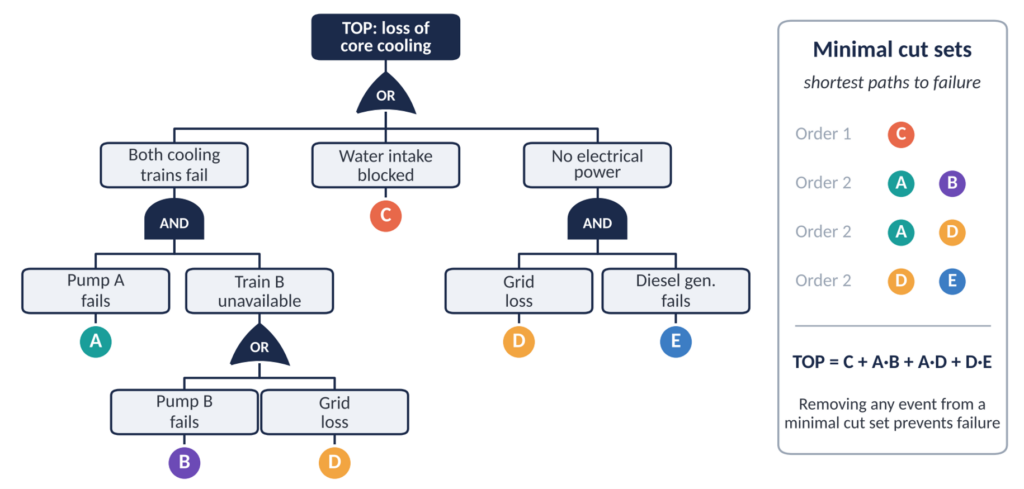
Power plants, dams and electrical substations are designed so that no single failure can lead to an accident. Probabilistic Safety Assessment (PSA) checks, in numbers, that this is true. Its workhorse is the fault tree: a logical diagram whose root, the top event (for instance a loss of core cooling), is connected through AND and OR gates to basic events such as a pump failing or the grid going down (Figure 1).
A cut set is any combination of basic events that triggers the top event. A minimal cut set (MCS) contains nothing superfluous: remove any one event and the system survives. MCSs are the shortest paths to failure. They show engineers where redundancy is missing, and their probabilities feed directly into the risk figures examined by operators and regulators.
A combinatorial wall
Mathematically, a fault tree is a Boolean function of its n basic events, and finding its MCSs is a satisfiability-type problem whose search space grows as 2ⁿ. With thousands of events in industrial models, classical tools must truncate, discarding cut sets below a probability threshold. As installations become larger and more interconnected, the challenge only grows.
Where quantum computing helps
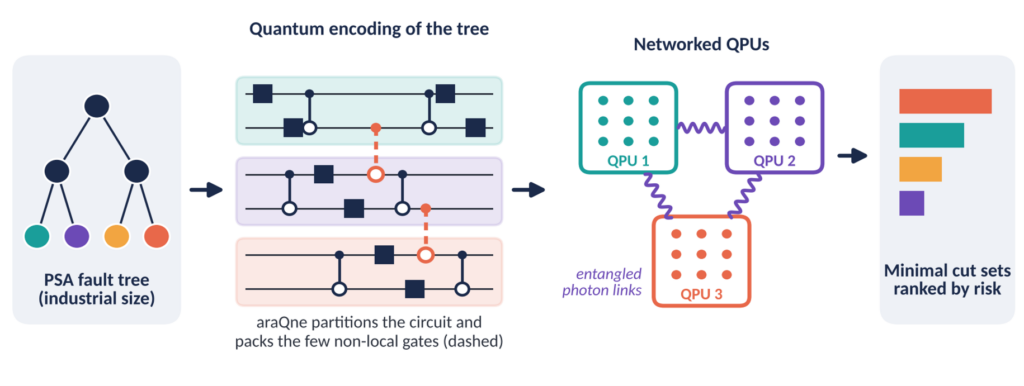
A fault tree can be translated into a quantum circuit, with one qubit per basic event and gates reproducing the logic of the tree, so that a superposition explores all failure configurations at once. Grover-type amplitude amplification then boosts the probability of measuring configurations that are minimal cut sets, with a quadratic reduction in the number of queries compared with unstructured search. Other formulations recast the problem as an optimisation (QUBO) for annealing and variational methods. Recent studies, some involving EDF, have shown that these encodings work on small trees.
The catch is size. An industrial tree needs one qubit per basic event plus ancilla qubits for the gates: hundreds to thousands of high-quality qubits, beyond what any single quantum processing unit (QPU) offers today.
Scaling out rather than scaling up
Distributed quantum computing (DQC) follows the path that made supercomputers possible: instead of building one giant processor, connect several mid-sized ones. In the AQADOC project, the circuit encoding a fault tree is cut into blocks, each executed on its own QPU. Gates that straddle two processors are performed by consuming entangled photon pairs delivered through Welinq’s quantum links. Fault trees are a natural fit: they are modular by construction, with subsystems (for example cooling trains, power supply, water intake) linked by relatively few logical connections.
araQne, the conductor of the orchestra
Our central tool is araQne, Welinq’s compiler for distributed quantum computing. It represents the circuit as a hypergraph, partitions it across the available QPUs, then reorders and packs the non-local gates so that each entangled pair serves as many operations as possible. Every pair saved means a faster and more reliable run: on benchmark circuits, these optimisations already reduce entanglement consumption by 10% to 30%, depending on the number of QPUs. For PSA, we are teaching the compiler to exploit the structure of the tree itself, aligning partitions with the natural subsystems of the installation.
The road ahead
The team is assembling the full chain, from standard fault-tree models to distributed execution plans, tested on simulators and benchmarked against classical PSA tools. Each step brings closer the moment when a cluster of networked quantum processors joins the safety engineer’s toolbox, helping the energy system stay safe as it grows.